Indian Coast Guard Conducts 12th National Maritime Search and Rescue Exercise 'SAREX-2026' in Paradip, Odisha
The exercise held at the Paradip coast aimed to strengthen maritime security and rescue preparedness, featuring observers from 30 countries including India.
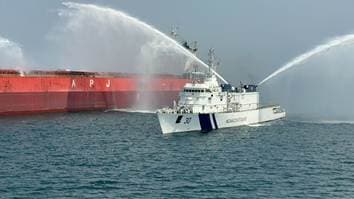
The Indian Coast Guard organized the 12th National Maritime Search and Rescue Exercise (SAREX-2026) near Paradip, Odisha, on October 8, 2026. The exercise was conducted under the supervision of the National Maritime Search and Rescue Board (NMSARB). This year's exercise was based on the theme “Utilization of Technology to Enhance Search and Rescue Preparedness and Maritime Security.”
The primary objective of the exercise was to demonstrate operational readiness, mutual coordination, and joint action capabilities for large-scale rescue operations at sea. Director General of the Indian Coast Guard, Parmesh Shivmani, observed the exercise. Various maritime and aerial agencies participated, including the Coast Guard, Indian Navy, Air Force, Shipping Corporation of India, Directorate General of Shipping, Department of Fisheries, Customs Department, Marine Police, Paradip Port Authority, and the Odisha state administration.
To promote international cooperation, 32 observers from 30 countries also participated in the exercise. Their involvement strengthened the coordination between various agencies, the exchange of best practices, and joint operational capabilities, reinforcing India's role as a reliable partner in the field of maritime search and rescue.
The exercise involved 15 ships of the Indian Coast Guard, three Dornier aircraft, three Advanced Light Helicopters, and one Chetak helicopter. Additionally, C-130J and Mi-17 aircraft of the Indian Air Force, two ships of the Indian Navy, civilian resources, and state government support units were deployed.
During the exercise, a joint crisis situation was simulated, depicting a scenario where a passenger aircraft carrying 228 passengers crashed into the sea near Paradip port and collided with a container ship named MV Zumba. The collision caused damage to the vessel and sparked a fire. To manage this situation, procedures such as activating the incident control center, firefighting, extracting people via helicopters, deploying lifeboats and equipment, and utilizing Jason Cradles, Gemini recovery, rescue baskets, and rescue nets were practiced. Additionally, the capabilities of Remotely Operated Vehicles (ROVs) were demonstrated.
SAREX-2026 reaffirmed the resolve of India and its international partners to develop a faster, technology-enabled, and better-coordinated search and rescue system in line with the 'SAGAR' vision and the spirit of the ocean.

_20260928170137_4f0d68.jpeg&w=3840&q=75)