PM Modi Inaugurates Semicon India 2026; Unveils New Roadmap for Semiconductor Sector via 'Semicon 2.0'
Prime Minister Narendra Modi inaugurated Semicon India 2026 in New Delhi and announced an increase in the budget for the Semiconductor Mission to 13.5 billion USD.
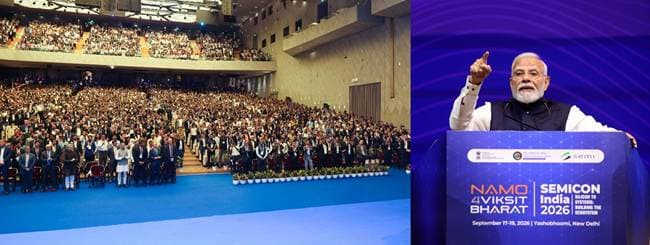
Prime Minister Shri Narendra Modi inaugurated 'Semicon India 2026', held from September 17 to 19, 2026, at Yashobhoomi in New Delhi. During this fifth edition, the Prime Minister unveiled India's ambitious roadmap for 'Semicon 2.0', which aims to provide expanded support for design, manufacturing, packaging, research and development (R&D), and talent development.
To accelerate progress in the semiconductor sector, the Prime Minister emphasized increasing the budget of the Indian Semiconductor Mission from 8 billion USD to 13.5 billion USD. He called upon global industries to partner in creating a competitive semiconductor ecosystem in India. On this occasion, the Prime Minister also virtually launched commercial production lines for discrete devices at CDIL Semiconductor in Mohali and for packaging at Suchi Semicon in Surat.
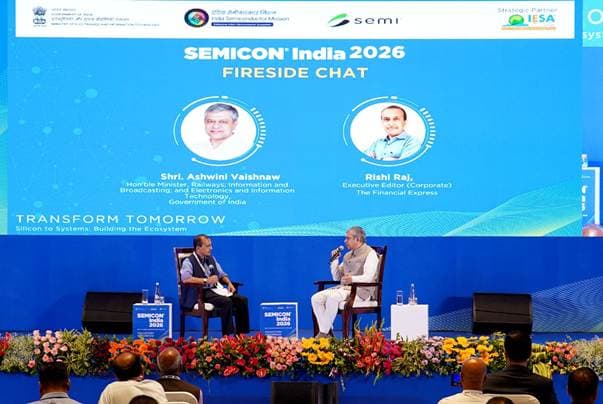
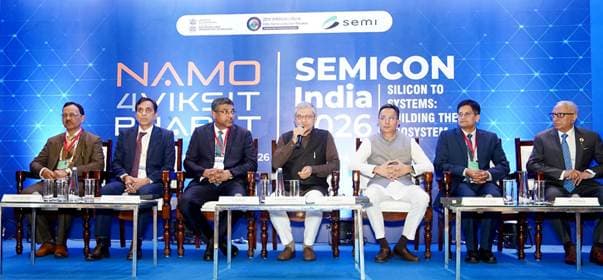
Union Minister for Electronics and IT, Shri Ashwini Vaishnaw, stated that under Semicon 1.0, 70,000 design engineers were trained and EDA tools were deployed across more than 500 organizations. Now, through Semicon 2.0, focus will be centered on six pillars: design, equipment and materials, fabs, advanced packaging, applied R&D, and talent.
Several global and Indian companies announced their plans during the event. Micron Technology CEO Sanjay Mehrotra shared that the production of commercial DRAM and NAND has commenced in Sanand, Gujarat. Tata Electronics CEO Dr. Randhir Thakur confirmed that the construction of the 300mm fab in Dholera and the OSAT facility in Jagiroad is progressing on schedule. Meanwhile, Lam Research announced an investment of approximately 10,000 crore rupees for its first silicon-component manufacturing and vertical ingot-processing plant in India.
Semicon India 2026 features over 600 exhibitors, 300 international participants, pavilions from six countries, and pavilions from twelve Indian states. Secretary of the Ministry of Electronics and IT (MeitY), Shri S. Krishnan, noted that India completed its initial six-year funding phase in just four years, leading to the transition into Semiconductor 2.0.