Reintroduction of Great Indian Bustard in Jaisalmer's Desert National Park Begins
The Union Environment Minister and the Chief Minister of Rajasthan have launched the process of reinstating the critically endangered Great Indian Bustard into its natural habitat.
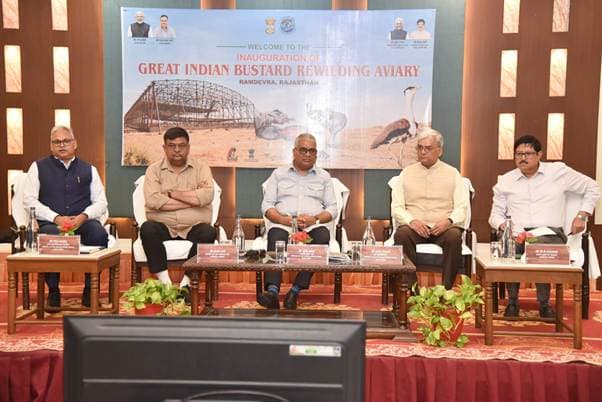
On the occasion of Wildlife Week 2026, Union Minister for Environment, Forest and Climate Change Shri Bhupender Yadav and Rajasthan Chief Minister Shri Bhajan Lal Sharma, via video conferencing, launched the process of releasing two captive-bred Great Indian Bustards (GIB) into the wild at the Desert National Park in Jaisalmer. This move is the result of a decade of scientific research and dedicated efforts aimed at developing a viable population of the state bird of Rajasthan.
During the program, the Union Minister and the Chief Minister reviewed the progress of the GIB conservation breeding centers located in Ramdevra and Sam. The event featured the inauguration of a newly constructed rewilding aviary and the release of a brochure detailing the decade-long journey of GIB conservation. Senior officials from the central and state governments, including Rajasthan's Forest and Environment Minister Shri Sanjay Sharma, were present at the event.
Union Minister Shri Bhupender Yadav stated that this project has extended from Rajasthan to Naliya in the Kutch district of Gujarat. Praising the vision of Prime Minister Narendra Modi, he noted that the program has become a global example. He emphasized that the conservation of the GIB would not only yield ecological benefits but also provide economic advantages to local communities through eco-tourism.
The rewilding aviary constructed in Ramdevra measures 160 meters by 64 meters by 14 meters. It was built by the Rajasthan Forest Department through the Rajasthan State Road Development and Construction Corporation Limited (RSRDC), with a budget of 9.25 crore rupees approved by the Rajasthan government. This pillar-less facility is designed to help captive birds develop their flight muscles and adapt to natural conditions.
The Bustard Recovery Program is a joint initiative of the Ministry of Environment, Forest and Climate Change, the Rajasthan Forest Department, and the Wildlife Institute of India (WII). It receives technical cooperation from the International Houbara Conservation Fund and financial assistance from the National CAMPA. Currently, there are 97 birds across the Sam and Ramdevra facilities, of which 40 were from wild eggs and 57 were born in captivity. Among these, 11 birds have been identified for release into the wild.
As part of the conservation efforts, a 'jumpstart' approach has been adopted, through which six chicks in Rajasthan and two in Gujarat were fostered in wild nests. Additionally, fenced grasslands covering approximately 200 square kilometers have been established within the Desert National Park. The entire process is being conducted under the guidance of the Supreme Court's decision and the recommendations of an expert committee.