Swachh Bharat Mission 2.0: Old Dumpsites Transformed into Eco Parks and Productive Land
Under the Government of India's Swachh Bharat Mission-Urban 2.0, old garbage dumpsites across the country are being scientifically treated and converted into productive and environmentally sustainable spaces.
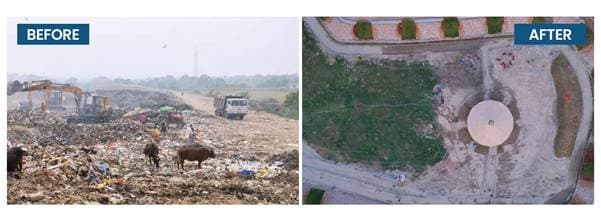
There has been a significant shift in the approach to urban waste management in India. The Swachh Bharat Mission-Urban (SBM-U), launched in October 2014, has now moved beyond basic sanitation to focus on the scientific management of urban waste and land reclamation. Under Swachh Bharat Mission-Urban 2.0, launched in October 2021, old dumpsites are being transformed into productive spaces. According to data, 3.66 crore metric tonnes of legacy waste were treated between January and December 2025, with 459 urban local bodies across 29 states achieving complete remediation of their dumpsites.
In Gorakhpur, Uttar Pradesh, a 40-acre area that was once a massive mound of municipal waste was cleared through biomining. Approximately 400 tonnes of waste were processed daily, separating it into waste-derived fuel, black soil, and recyclable materials. This land has now been developed as the 'Kanchan Rapti Eco Park,' featuring green lawns, jogging tracks, an open gym, a yoga area, and a children's play zone. A women-led self-help group, 'Shakti Ki Rasoi,' operates a restaurant here, and the park attracts approximately 500 visitors daily.
Biomining is also being carried out in mission mode at the Bhalswa dumpsite in the national capital, Delhi. This work, which began in July 2022, was further accelerated through the 'Dumpsite Remediation Accelerator Program' (DRAP) launched in November 2025. As a result, 99.07 lakh metric tonnes of legacy waste were treated by July 31, 2026, and more than half of the site was reclaimed by May 2026.
In Nagpur, Maharashtra, the Bhandewadi dumping yard has been converted into an integrated municipal solid waste processing unit. More than 10 lakh metric tonnes of accumulated waste were treated and converted into compost and waste-derived fuel. This initiative has reduced dependence on landfills and improved air, water, and soil quality in surrounding areas.
In Raichur, Karnataka, the 35-acre Yakalpura dumpsite is being treated, with 22 acres of land reclaimed so far. A Miyawaki forest has been developed across 5 to 7 acres, where approximately 60,000 bamboo and native plants are being planted to enhance biodiversity. This plantation drive was initiated on June 5, 2026, on World Environment Day.
According to the Ministry of Housing and Urban Affairs, this campaign is not limited to cleaning alone, but is an effort to restore ecology and promote sustainable urban development by transforming barren mountains of waste into reusable land.