Two-Day Conference on 'Financing the Journey to Developed India' Concludes in New Delhi
Finance ministers from the center and states, along with experts, discussed financial resources, private investment, and fiscal strategies necessary to make India a developed nation by 2047.
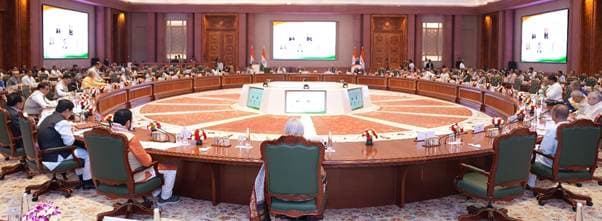
A two-day conference themed "Financing India's Journey to Developed India" concluded in New Delhi, bringing together finance ministers of states and union territories, finance secretaries, members of legislatures, academics, and banking experts. The conference featured detailed deliberations on India's future financial requirements and pathways toward sustainable and inclusive growth.
The event was attended by the Union Minister for Finance and Corporate Affairs, as well as the Chief Ministers of Assam, Delhi, Goa, Haryana, Jammu-Kashmir, Kerala, Manipur, Meghalaya, and Nagaland. The Deputy Chief Ministers of Arunachal Pradesh, Bihar, and Odisha, along with finance ministers from several states, were also present.
On the first day of the program, Mrs. Anuradha Thakur, Secretary of the Department of Economic Affairs (DEA), stated that this is the first conference of its kind to bring together issues of public and private finance. She noted that international rating agencies have improved India's sovereign rating over the past 16-17 months, with JCR recently upgrading India's rating from BBB+ to A-. Mrs. Thakur emphasized that the goal of a developed India cannot be achieved through government budgets alone; instead, private sector financing and innovative mechanisms will play a critical role.
Mr. N. K. Singh, Chairman of the 15th Finance Commission, mentioned in his address that the GDP saw a growth of 7.8 percent in the first quarter of the 2026-27 financial year. He suggested that to maintain a growth rate of 7-8 percent for a developed India, the gross domestic savings rate must be increased from the current 34 percent to 38-40 percent. He stressed the use of Artificial Intelligence (AI) and Machine Learning to mobilize revenue rather than increasing tax rates.
The second day of the conference featured special sessions on the transformation of the agricultural sector and the financing of energy transition. The agriculture session focused on market access and reliable financing, while the energy session shared views on topics such as renewable energy, battery storage, and the carbon credit framework. Additionally, Dr. Saurabh Garg, Secretary of the Ministry of Statistics, delivered a presentation on the measurement of growth from the perspective of Gross State Domestic Product (GSDP), and Mr. S. Krishnan, Secretary of the Ministry of Electronics and IT, presented on the role of new-age technology.
In the closing session, Chief Economic Advisor Dr. V. Anantha Nageswaran stated that the participation of private capital is mandatory for mobilizing investment. He outlined three priorities for the states: creating a favorable environment for private investment, improving project-readiness processes, and strengthening capital expenditure despite fiscal constraints. He also referenced a proposal by Mr. Sudhir Srivastava, which suggested increasing capital expenditure from 2.4 percent of GSDP to 3 percent by 2031-32.