Two Male Great Indian Bustards Released into Jaisalmer's Desert National Park, Marking Major Success for Conservation Program
Union Environment Minister Bhupender Yadav released two male birds of the critically endangered Great Indian Bustard into the wild in Jaisalmer, Rajasthan.

Union Minister for Environment, Forest and Climate Change, Shri Bhupender Yadav, released two male birds of the critically endangered Great Indian Bustard (GIB) into the wild at the Sam area of the Desert National Park in Jaisalmer, Rajasthan. The event was attended by Rajasthan's Minister for Forest and Environment, Shri Sanjay Sharma, along with senior officials from both the central and state governments.
Union Minister Shri Bhupender Yadav attributed this achievement to nearly a decade of unwavering dedication by scientists, researchers, and ground staff. On the social media platform 'X', he thanked Prime Minister Shri Narendra Modi for his continuous guidance and support. The Minister stated that this move represents a significant shift in India's GIB conservation program, moving beyond the establishment of a conservation-breeding population toward the reintroduction of the species into their natural habitat.
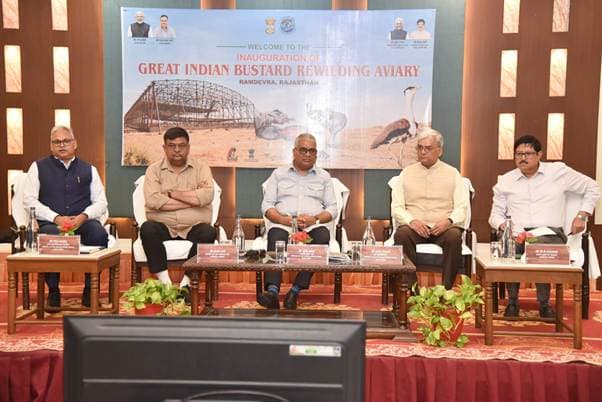
The 'Bustard Recovery Program' is a joint initiative of the Ministry of Environment, Forest and Climate Change, the Rajasthan Forest Department, and the Wildlife Institute of India (WII). It receives technical and financial support from the International Fund for Houbara Conservation and National CAMPA. The program primarily focuses on conservation breeding, habitat management, threat mitigation, habitat restoration, and community engagement.
Under the conservation-breeding program, there are currently a total of 97 birds at the Sam and Ramdevra facilities, including 40 hatched from wild eggs and 57 captive-bred birds. Among these, 86 birds are maintained for captive breeding, while 11 were designated for release into the wild, two of whom were released today. Captive breeding resulted in 24 live chicks in 2025 and 29 in 2026.
A novel scientific approach called 'Jumpstart' was adopted for the species' recovery, where captive-led eggs placed in wild nests were accepted by females. This resulted in the birth of six chicks in Rajasthan and two in Gujarat. Additionally, the Rajasthan Forest Department is developing fenced grasslands across approximately 200 square kilometers within the Desert National Park. Telemetry studies by the WII have identified these areas as key breeding habitats. All conservation efforts are being carried out in accordance with the recommendations of an expert committee and the guidelines set by the decision of the Supreme Court of India.