Amit Shah Outlines Roadmap for Drug-Free India by 2029 at 3rd National Conference of ANTF Heads
Union Home Minister Amit Shah has set a goal to make India free from the drug trade by December 31, 2029, while inaugurating the 3rd National Conference of ANTF heads in New Delhi.
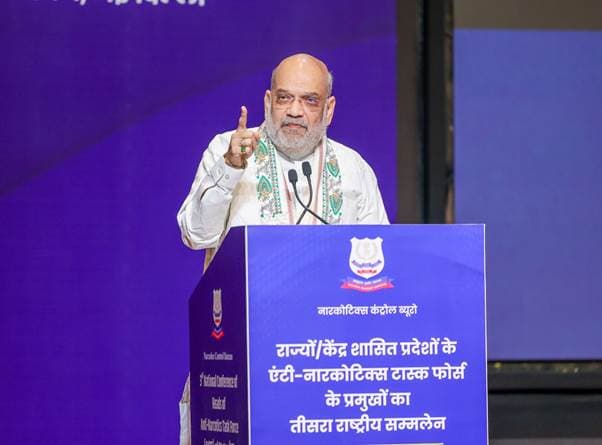
Union Minister of Home Affairs and Cooperation, Shri Amit Shah, inaugurated the 3rd National Conference of the heads of Anti-Narcotics Task Forces (ANTF) from states and Union Territories in New Delhi. This two-day conference is attended by ANTF heads from 36 states and Union Territories, alongside representatives from relevant government departments and stakeholders.
During the event, the Union Home Minister launched a Television Commercial (TVC) to raise awareness against narcotics, released the new website of the Narcotics Control Bureau (NCB), and laid the foundation stones for new NCB Zonal Complexes in Lucknow and Dehradun. ANTFs that demonstrated outstanding performance were also honored during the program.
In his address, Shri Amit Shah stated that a roadmap for a drug-free India is critically important to achieving Prime Minister Narendra Modi's goal of a developed India by 2047. He announced that the target has been set to uproot the drug trade from India by December 31, 2029. He expressed a resolve that not a single gram of drugs would be allowed to enter India, nor would they be permitted to leave the country via Indian routes.
Referring to the 'Vision Document 2026-2029,' the Home Minister explained that it was prepared after consultations with more than 35 departments. This vision document is based on four main pillars: intelligence and operation-based enforcement, control over precursors and synthetic drugs, demand and harm reduction, and capacity building and coordination. Over 100 targets have been established under these pillars.
Discussing the strategy, Shri Shah emphasized that the focus must now shift from a purely 'seizure-centric' approach to dismantling drug networks. He directed that districts be divided into three clusters: districts that are production hubs or entry points, districts serving as transportation corridors, and consumption districts. He spoke about striking the cartels at three levels: entry points, inter-state distribution systems, and local cell networks.
To raise awareness among the youth, the 'Nashamukt Mitra' campaign will spread awareness across 1 million schools, colleges, and institutions. To date, 46,780 Nashamukt Mitras have been registered.
The Union Home Minister suggested forming teams of officers capable of 'out-of-the-box' thinking in every state to tackle digital challenges such as the darknet, cryptocurrency, and dead-drop delivery systems. Additionally, he emphasized blacklisting foreign accused individuals and extraditing fugitives supplying drugs from abroad to face trial in Indian courts. He stated that the journey must now move from 'meetings to missions, reporting to results, seizures to network termination, and cases to convictions.'