Powerful Jets from Black Holes Determine the Future of Galaxies, Research Finds
Indian and American scientists have discovered how jets from black holes located at the center of galaxies affect gas reserves to halt the formation of stars.
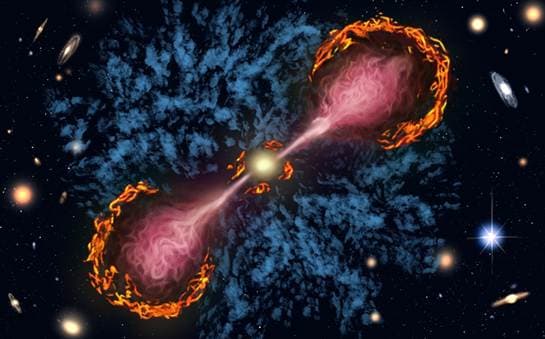
Astronomers have discovered a process through which black holes located at the centers of galaxies can influence the vast and sparse reserves of gas surrounding their host galaxies. This process ultimately holds the potential to shape the future of these galaxies.
Extending beyond the edge of a galaxy's disk is a sparse envelope that reaches 10 to 20 times further than the size of the galaxy itself. This reservoir of gas is known as the 'Circumgalactic Medium' (CGM), which provides the necessary fuel for the formation of stars. If all this gas were to gather and convert into stars, extremely bright galaxies would be created; however, such galaxies do not actually exist. Scientists believe that energy emitted from the supermassive black holes (SMBH) at the center prevents this gas from cooling and contracting.
A team of researchers from the Raman Research Institute (RRI), an autonomous institute of the Department of Science and Technology (DST), and Arizona State University have explored the mechanics of this effect. The study found that black holes often eject jets of extremely hot plasma. When these jets first encounter the CGM, they collide with the gas, creating a shock that makes the gas energetic and ionized. This energized gas disrupts the process of new star formation within the galaxy.
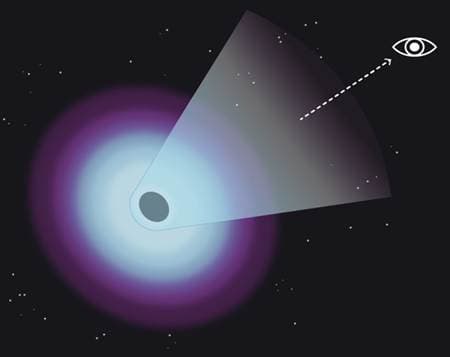
According to Namrata Roy, an Assistant Professor at RRI and the lead author of the research paper published in 'The Astrophysical Journal Letters,' the jets were only illuminating the gas in their path, rather than affecting the gas uniformly in all directions. The research found that this signal is strongest at two locations: the edge of the stellar disk and the outer boundary of the CGM.
Sanchayita Borthakur, an Associate Professor at Arizona State University and co-author of the study, stated that the broader implication is that black holes can influence the life of galaxies far beyond their small central regions. In this way, black holes determine the future of the galaxy by making it quiet and inactive.