High-Level CAQM Team Visits Amritsar and Tarn Taran to Prevent Stubble Burning
The Commission for Air Quality Management (CAQM) reviewed stubble management in Punjab's hotspot districts and has deployed flying squads across 18 districts for monitoring.
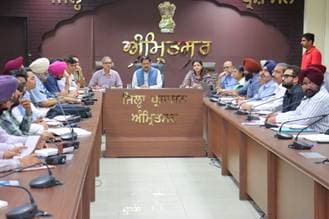
A high-level team from the Commission for Air Quality Management (CAQM) for the National Capital Region (NCR) and adjoining areas visited the Amritsar and Tarn Taran districts of Punjab. The team was led by Dr. S.D. Attari, Member (Technical). Both districts have been identified as 'hotspot' areas for paddy stubble burning. The primary objective of this visit is to reduce and eliminate incidents of paddy straw burning, which is a major cause of air pollution in the NCR and surrounding regions during winter.
A review meeting held in Amritsar was attended by the Deputy Commissioners of Amritsar and Tarn Taran, along with other district-level officials. The meeting reviewed the district administration's preparations and mutual coordination for both in-situ (in-field) and ex-situ (outside-field) management of paddy straw. The Commission emphasized the timely availability of Crop Residue Management (CRM) machinery for farmers, the spread of awareness, and the intensification of Information, Education, and Communication (IEC) activities.
On October 9 and 10, 2026, the team conducted ground visits to hotspot villages and facilities. Discussions in the Amritsar district focused on crop harvesting, procurement, and the availability of CRM machinery. Baler machines are being utilized for stubble management here, and a supply chain has been established with boiler industries for the use of straw bales. The administration has also issued a control room, help desk, and helpline number to facilitate the provision of machinery to farmers and ensure rapid action against stubble burning incidents.
During the review of Tarn Taran district, it was reported that the district administration has largely achieved its targets for CRM machinery availability, and baler machines are also operational there for ex-situ management. Instructions were given to strengthen field patrolling and monitoring through nodal and cluster officers.
To fortify the monitoring system, the Commission has deployed 'flying squads' in 18 districts of Punjab from October 1, 2026, to November 30, 2026. These districts include Sangrur, Tarn Taran, Firozpur, Muktsar, Bathinda, Amritsar, Moga, Mansa, Fazilka, Patiala, Ludhiana, Kapurthala, Faridkot, Barnala, Malerkotla, Gurdaspur, Jalandhar, and Fatehgarh Sahib.
CAQM has directed strict implementation of low-cost sensors and other monitoring methods in hotspot areas. Additionally, it has called for close coordination between farmers, collectors, and industries to effectively prevent stubble burning incidents during the current harvesting season.