India Targets FMD-Free Status by 2030: Three-Day Workshop Concludes in New Delhi
The Department of Animal Husbandry and Dairying, in collaboration with WOAH, organized a workshop to develop FMD-free zones and strengthen public-private partnerships.
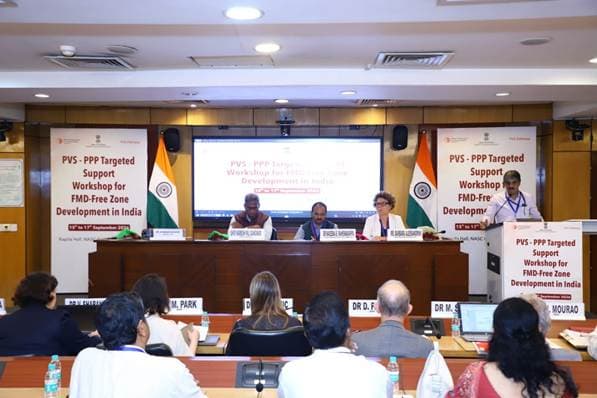
The Department of Animal Husbandry and Dairying (DAHD), under the Ministry of Fisheries, Animal Husbandry and Dairying, organized a three-day PVS-PPP Targeted Assistance Workshop from September 15 to 17, 2026, at the National Agricultural Science Complex (NASC) in New Delhi. The workshop was held in collaboration with the World Organisation for Animal Health (WOAH), with the central theme of "FMD-Free Zone Development in India."
The event saw participation from the DAHD, animal husbandry departments from 12 states, WOAH Paris, the National Dairy Development Board (NDDB), ICAR research institutes, industry representatives, and technical experts. The objective of the workshop was to strengthen national and state-level FMD-free zone action plans through technical analysis, Public-Private Partnership (PPP) design, and adherence to WOAH standards.
Mr. Naresh Pal Gangwar, Secretary of the Department of Animal Husbandry and Dairying, stated that India aims to control Foot and Mouth Disease (FMD) and make the country completely free of the virus by the year 2030. He informed that more than 147.16 crore FMD vaccine doses have been administered so far, benefiting approximately 8.04 crore farmers. According to the data, FMD outbreaks decreased from 132 in 2019 to 40 in 2025, and further dropped to 20 by August 2026. Additionally, a decline of 8.1 percent in NSP antibody positivity was recorded by 2025.
Mr. Gangwar further clarified that the department has developed guidelines for creating FMD-free zones and established minimum standards for veterinary infrastructure in 2025. States are being provided capital investment assistance under the State Assistance (SASCII) framework to address their infrastructure gaps.
During the workshop, representatives from nine priority states presented their proposed action plans, which received technical feedback from WOAH experts. Discussions focused on critical points such as vaccination systems, surveillance, diagnostic partnerships, animal identification, and investment models. The workshop emphasized that Public-Private Partnerships (PPP) should not be limited to financial assistance but should encompass all aspects, including vaccine supply, distribution, diagnostics, and risk communication.
In the closing session, Commissioner of Animal Husbandry Dr. Navina B. Maheshwarappa expressed confidence that state governments would translate these outcomes into evidence-based and time-bound action plans. This initiative marks a significant step toward India's national goal of being declared FMD-free by 2030.