PM-AJAY: A Major Step Toward Socio-Economic and Educational Empowerment of Scheduled Caste Communities
The Central Government's Pradhan Mantri Anusuchit Jaati Abhyuday Yojana (PM-AJAY) aims to reduce poverty and improve infrastructure for Scheduled Caste communities through an integrated approach.
The Government of India has launched the 'Pradhan Mantri Anusuchit Jaati Abhyuday Yojana' (PM-AJAY) to promote the holistic development, socio-economic advancement, and educational empowerment of Scheduled Caste (SC) communities. Launched in the financial year 2021-22, this is a fully centrally sponsored scheme implemented by the Ministry of Social Justice and Empowerment.
The scheme was created by merging three previous centrally sponsored schemes: the Pradhan Mantri Adarsh Gram Yojana (PMAGY), the Special Central Assistance to Scheduled Castes sub-scheme (SCA to SCSP), and the Babu Jagjivan Ram Chhatrawas Yojana (BJRCY). To ensure the rapid implementation of the scheme, the government has also launched the 'PM-AJAY' portal and a mobile application.
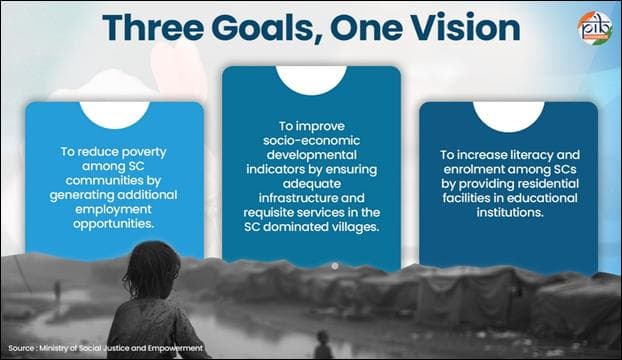
Three primary objectives have been set for PM-AJAY: first, to reduce poverty by increasing employment opportunities through skill development and income generation. Second, to improve infrastructure and essential services in SC-dominated areas. Third, to increase literacy and encourage enrollment in educational institutions by providing quality residential facilities.
According to the eligibility criteria of the scheme, priority for Grant-in-Aid (GIA) is given to families whose annual income does not exceed 2.50 lakh rupees. For infrastructure development, villages are eligible if the Scheduled Caste population is 40% or more and the total population is 500 or more.
The main components of the scheme's implementation are as follows:
Development of Adarsh Gram: Under this component, SC-dominated villages are being transformed into 'Adarsh Grams' (Model Villages). So far, 47,243 villages have been included in this component, benefiting over 47.79 lakh citizens. By September 8, 2026, 18,093 villages have been declared Adarsh Grams, and 46,944 development works have been completed.
Grant-in-Aid: Financial assistance is provided for socio-economic projects at the state and district levels. From the financial year 2021-22 to 2025-26, more than 1,730 crore rupees have been released to states, providing skill development and livelihood support to over 2.5 lakh beneficiaries.
Hostel Construction: To encourage students in their education, hostels are being constructed and renovated. By September 2026, 785 hostels have been completed. For the financial year 2026-27, 61.46 crore rupees have been allocated for two new hostel projects, which will provide accommodation for 264 students.
Under the funding framework, the scheme is 100% funded by the Central Government. Up to 50% of the allocated budget is designated for Adarsh Gram works, 5% for Technical Support Groups (TSG) and Project Implementation Units (PIU), and 2% for hostels of central institutions. The remaining amount is allocated for projects at the district and state levels.