Central and State Governments Form Joint Strategy to Curb Delhi Air Pollution; Campaign at Hotspots Until October 10
Union Environment Minister Bhupender Yadav and Chief Minister Rekha Gupta reviewed Delhi's air pollution mitigation plan, emphasizing coordinated action and public participation before winter.
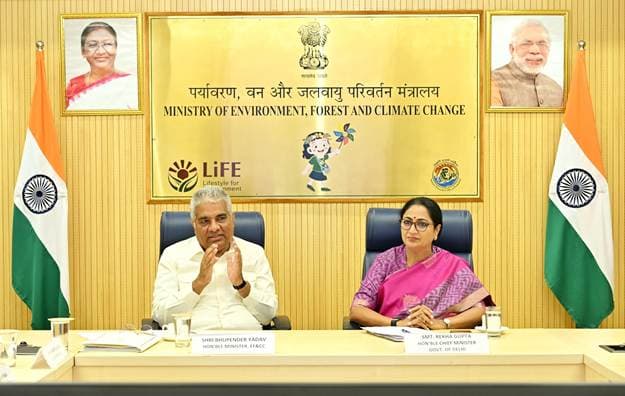
Union Minister for Environment, Forest and Climate Change, Shri Bhupender Yadav, chaired a high-level meeting with Delhi Chief Minister Smt. Rekha Gupta. The primary objective of the meeting was to review the Delhi government's air pollution mitigation action plan and assess the progress of steps taken to control pollution in the national capital. Detailed discussions were held regarding necessary additional interventions before and during the winter season.
Union Minister Bhupender Yadav called for the organization of public participation programs at 37 identified hotspots in Delhi until October 10. He directed that actionable points for each hotspot be identified and inspected on the ground by public representatives. Shri Yadav also mentioned organizing a meeting with the Union Agriculture Minister and the agriculture ministers of NCR states to prevent pollution resulting from agricultural activities. He emphasized that action plans for NCR areas should be finalized before October 10.
Discussing measures to improve air quality, Chief Minister Smt. Rekha Gupta highlighted the need for better coordination in enforcement and traffic management. She suggested the use of technology, such as cameras, to monitor construction sites and increasing awareness regarding electric cremation facilities to reduce emissions from crematoriums.
A comprehensive winter strategy was developed during the meeting, focusing on the following key action points:
'No PUCC, No Fuel': This will be implemented in mission mode across all 500 ANPR-enabled fuel stations in the city. Action will be taken against petrol pumps violating these rules.
Public Transport: A campaign will be conducted from October 1 to 10 to promote the Delhi Metro Sarathi app. Currently, Delhi's bus fleet consists of 6,840 buses, including 5,088 e-buses.
Hotspots and Road Management: Regular visits will be made to traffic hotspots. The Delhi government stated that 8 road sections have been made signal-free, with a target to complete the remaining 7 by October 2026.
Dust Mitigation and Road Work: Road redevelopment work is targeted for completion by November 15. So far, work on 1,193 kilometers of roads has been completed.
Waste Management: Dedicated monitoring teams will be deployed at the ward and district levels by October 15 to prevent the open burning of waste.
Green Zones: Emphasis has been placed on greening barren areas. To date, 7.1 million saplings have been planted, and 433 out of 434 acres of barren land have been converted into green zones.
Restrictions on Construction Activities: To control dust, restrictions will be placed on certain construction activities from November 1 to January 31, while a complete ban on all construction and demolition activities will be enforced from December 10 to January 20.
Winter Protocol: From November 1, 2026, vehicles registered outside Delhi and those below BS-VI standards (excluding CNG and EV) will be restricted from entering. Additionally, doubling parking fees and implementing a 50 percent work-from-home arrangement are under consideration.
Industrial Pollution: The number of monitoring centers will be increased from 47 to 60, and 334 enforcement teams will be deployed against industries violating regulations.
The meeting was attended by Secretary of the Ministry of Environment Shri Tanmay Kumar, Chairman of the Commission for Air Quality Management (CAQM) Shri Rajesh Verma, and senior officials from the CPCB, DPCC, MCD, and Delhi Police.