India International Water Week 2026: Focus on Climate Resilience and Water Financing; Key Agreements Signed Between India and Netherlands
The third day of the 9th India International Water Week focused on climate risks, glacial lake monitoring, and water infrastructure financing, featuring two tripartite agreements between India and the Netherlands.
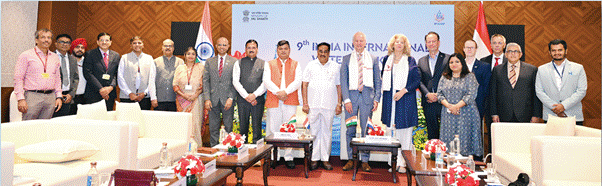
The sequence of technical sessions and strategic discussions continued on the third day of the 9th India International Water Week 2026, held at Bharat Mandapam in New Delhi. The primary focus of the day remained on critical themes such as climate risk assessment, early warning systems, glacial lake monitoring, water use efficiency, and innovative financing.
Bilateral cooperation between India and the Netherlands was strengthened during the event. A meeting took place between the Minister of Jal Shakti, Mr. C.R. Patil, and the State Secretary for Infrastructure and Water Management of the Netherlands, Mr. Jaap Sluitmaker. The meeting was attended by Minister of State for Jal Shakti Mr. Raj Bhushan Chaudhary, Mr. Ishwarsingh Patel, and other senior officials. During this session, two significant tripartite agreements were signed. The first agreement for technical assistance was signed between the Central Water Commission (CWC), the Kalpsar Department of the Government of Gujarat, and Deltares of the Netherlands. The second agreement, focused on capacity building and training, was signed between the CWC, the Kalpsar Department, and TU Delft of the Netherlands. These agreements aim to leverage Dutch expertise and advanced engineering practices in project planning and design.
Various forums discussed diverse aspects of water management. The Country Forum, in collaboration with the World Bank, deliberated on mobilizing private investment in urban water and irrigation. The Water Leaders Forum addressed topics such as smart metering and climate risk assessment, with participation from institutions including ICHARM (Japan), IIT Bombay, and IISc Bangalore. Meanwhile, the Practitioners Forum reviewed the integration of traditional water culture with modern climate-resilient management and explored alternative mechanisms for resolving inter-state river water disputes.
During the thematic forums, research papers were presented on indigenous glacier-lake monitoring systems, such as 'HIM JHEEL NETRA,' and AI-based data governance. Discussions on green finance and water user charge policies were also held under the innovative financing models.
To encourage the participation of youth and academia, a Start-up Forum was organized, where MSMEs and academic institutions presented water management solutions. Under the 'Jal Seva Adhyayan' initiative, launched in collaboration with AICTE, 49 teams visited 132 villages across the country to gain ground-level experience. Addressing the students, Minister of Jal Shakti Mr. C.R. Patil stated that the Jal Jeevan Mission is not merely an infrastructure program but a transformative initiative linked to health, dignity, and women's empowerment. He urged the youth to develop affordable technical solutions for the water sector.