Khadi and Village Industries: A Powerful Medium for Rural Livelihood and Women Empowerment
Khadi and village industries are strengthening the vision of a self-reliant India through employment generation, women empowerment, and sustainable development in rural areas.
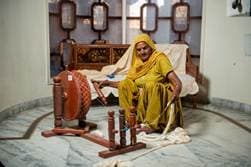
Khadi and Village Industries (KVI) are playing a pivotal role in promoting rural livelihoods and realizing the vision of Atmanirbhar Bharat (Self-reliant India) through the creation of employment opportunities. Deeply rooted in India's cultural heritage, Khadi provides economic opportunities in rural regions by blending traditional craftsmanship with sustainable production methods. This sector specifically supports the objectives of Sustainable Development Goal 1 (No Poverty) and Sustainable Development Goal 8 (Decent Work and Economic Growth).
The Khadi and Village Industries Commission (KVIC) has provided extensive support to institutions through skill development and capacity building. The income of artisans has improved due to an increase in spinning and weaving wages starting from April 2025, the provision of better work equipment, and robust marketing interventions.
Khadi has now become a part of modern fashion. Categories such as Khadi denim, designer sarees, bridal wear, and modern shirts have increased its popularity among the youth. The Khadi Centre of Excellence at NIFT in Delhi has developed 2,129 design collections, while the launch of the 'Navyug Khadi' and the yoga wear collection 'Swadha' have strengthened its modern image.
The government is providing financial assistance, training, and social security through the Khadi Development Scheme, Village Industries Development Scheme, and the Prime Minister's Employment Generation Programme (PMEGP). According to an evaluation study by the EDII in Ahmedabad, more than 75 percent of the artisans associated with these schemes have seen a significant increase in their income.
Khadi has proven to be an effective medium for women's empowerment. Out of approximately five lakh Khadi artisans, nearly 80 percent are women. Participation in sectors such as incense sticks, handmade paper, and the honey industry is providing these women with economic independence.
To bring international recognition to Khadi, registration has been completed as an Export Promotion Council (EPC) on the trade portal of the Consulate General of India in New York. Additionally, the GI tag for Ponduru Khadi is expected to increase its uniqueness and value. Ponduru Khadi, India Kasturi Cotton, and Bengal Muslin were showcased at the first BRICS MSME Forum held in Agra.
Under technical upgrades, KVIC's Central Sliver Plants are being modernized. Plants located in Chitradurga, Karnataka, and Kuttoor, Kerala, are already operational. The Chitradurga plant utilizes solar energy for 50 percent of its energy requirements. Furthermore, there is a proposal to construct technology-based Common Facility Centres for village industry clusters.
Towards environmental sustainability, KVIC, in collaboration with ICAR-CIRCOT, is developing naturally colored cotton varieties to reduce chemical pollution and water consumption. This initiative has the potential to contribute to Sustainable Development Goal 12 (Responsible Consumption and Production) and Sustainable Development Goal 13 (Climate Action).