Military Nursing Service Centenary Celebrations Discuss Digital Innovations and Compassionate Care
The MNS Centenary Scientific Conference held at the Manekshaw Centre in Delhi emphasized the role of AI and multilingual technologies in healthcare.
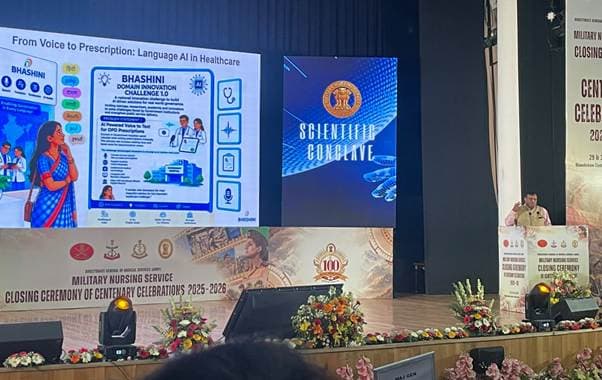
The Military Nursing Service (MNS) organized a scientific conference as part of the concluding ceremonies for its Centenary Year 2026 at the Manekshaw Centre in Delhi Cantt. The theme of the conference was “Digital Innovations in Nursing Practice: Harmonizing Technology and Compassionate Care.” The event brought together senior leadership, nursing professionals, healthcare practitioners, and technology experts to deliberate on the role of digital innovations in strengthening health services.
Chief Guest for the event was General Upendra Dwivedi, Chief of the Army Staff. During the inaugural ceremony, Mr. Amitabh Nag, CEO of Bhashini, delivered the keynote address on the topic “Technology in Health: Scope of Digital Health Opportunities in Transforming the Healthcare Landscape.” The occasion also saw the release of the MNS Diary and the Nursing Research Compendium, along with the e-release of a scientific souvenir titled “Digital Pulse of Nursing: Connecting Technology, Transforming Care.”
In his address, Mr. Amitabh Nag discussed the transformative potential of digital technologies in healthcare. He stated that language, context, and specific health data are essential for developing precise technology tailored to the needs of patients and health professionals. He detailed the four pillars of Bhashini, which include speech and translation technologies, emphasizing that these tools can make health systems more inclusive and reduce communication barriers within India's diverse linguistic environment.
Mr. Nag highlighted the necessity of developing medical and nursing terminologies as foundational resources for AI systems focused on healthcare. He explained that while medical terminology is standardized, patients often describe their symptoms in everyday language. Therefore, AI systems require specific language data to understand this diversity and create a common ground between clinical terminology and common speech.
He also mentioned the 'Bhashini Domain Innovation Challenge,' which encourages technical solutions for challenges in health communication. An example cited was an AI-powered voice-to-text tool for OPD prescriptions, which could make clinical workflows and documentation more efficient. Speaking on compassionate healthcare, Mr. Nag said, “Context is important, care is important, compassion is important, and in healthcare, these three become even more critical when we communicate with people in a language they understand.”
It is noteworthy that the Digital India Bhashini Division (DIBD) operates under the Digital India Corporation (DIC) within the Ministry of Electronics and Information Technology (MeitY). It serves as India's national platform for AI-powered multilingual digital inclusion. Bhashini currently supports over 800 government websites and provides support for 36 Indian text languages, 23 Indian voice languages, and 35 international languages.