Swachh Bharat Mission: Rural Sanitation Evolves from Infrastructure to a Mass Movement
Through the Swachh Bharat Mission-Gramin, India has achieved 100 percent sanitation coverage and is now focusing on solid and liquid waste management through ODF Plus villages.
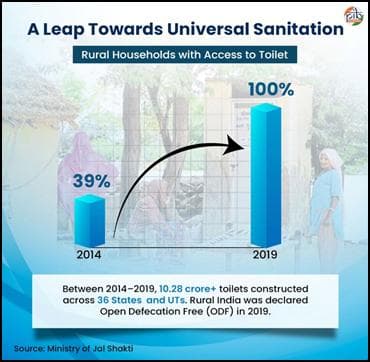
The landscape of sanitation in rural India has undergone a complete transformation over the last decade. At the launch of the Swachh Bharat Mission (SBM) in 2014, sanitation coverage was only 39 percent, which rose to 100 percent by 2019. During this period, over 10.28 crore toilets were constructed across 36 states and union territories, leading to rural India being declared 'Open Defecation Free' (ODF).
The mission's emphasis has now shifted to the second phase of Swachh Bharat Mission-Gramin, with the primary objective of sustaining ODF status and strengthening solid and liquid waste management systems. As of September 17, 2026, 5.69 lakh ODF Plus villages have been established in India, of which 5.25 lakh have achieved 'ODF Plus Model' status. Additionally, arrangements for solid waste management have been implemented in 5.38 lakh villages, and liquid waste management in 5.65 lakh villages. Currently, 1,314 GOBARdhan biogas plants are operational across 582 districts, while 12.22 crore toilets and 98,273 biogas plants have been constructed at the individual level.
The role of women has been critical in this campaign. Under SBM-G, women have been prioritized as 'Swachhagrahis,' and DAY-NRLM Self-Help Groups (SHGs) are being utilized as platforms for Behavior Change Communication (BCC). For instance, in Howrah, West Bengal, SHGs collected 9.32 tons of plastic waste in just 18 days. In Gorakhpur, Uttar Pradesh, women are operating 'Resource Recovery Centers' where wet waste is converted into vermicompost.
The sanitation drive has also reached children through schools. In Chandil, Jharkhand, a school banned single-use plastics and constructed soak pits for grey-water management. Under the 'Swachhata Hi Seva 2026' campaign, students are being made aware of 'Swachhata and Jal Samvad' and the Solid Waste Management (SWM) Rules, 2026.
At the community level, the roles of Gram Panchayats and Village Water and Sanitation Committees (VWSC) are pivotal. The Gadli Gram Panchayat in Haryana achieved ODF Plus Model status through community efforts. Similarly, Karnataka's 'Swachh Shanivar' (Clean Saturday) campaign is a successful example of public participation, where public spaces are cleaned on the first Saturday of every month.
This mission has also created new employment opportunities. In Betul, Madhya Pradesh, Babita Dhurve became the district's first female e-rickshaw waste collector. In Nadia, West Bengal, the demand for trained masons increased due to toilet construction, providing training to approximately 2,400 people. Vedancha village in Gujarat has emerged as a model, treating 200 kiloliters of water daily through a grey-water treatment system, enabling the panchayat to earn approximately 2.5 lakh rupees annually.
Over 18.06 crore citizens participated in the 'Swachhata Hi Seva' campaign in 2025. The upcoming 'Swachhata Hi Seva 2026' will begin on September 17, with the theme "Participation in Sanitation; Clean India, Developed India." This will include collective voluntary labor (Shramdan) on October 1 and the organization of special Gram Sabhas on October 2.