Government Launches Major Mission for Self-Reliance in Pulses Production, Targets 350 Lakh Tonnes by 2030-31
The Government of India has launched the 'Mission for Self-Reliance in Pulses' with an allocation of ₹11,440 crore to achieve self-sufficiency in pulse production by 2030-31.
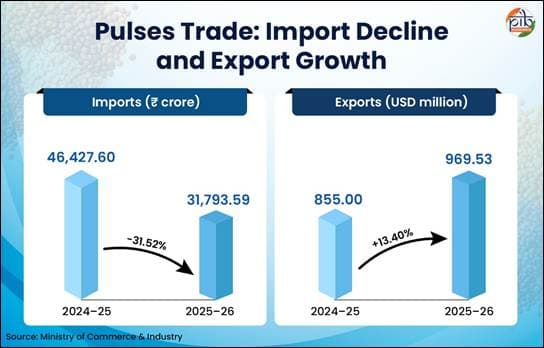
The Government of India launched the 'Mission for Self-Reliance in Pulses' on October 11, 2025, with the aim of achieving self-sufficiency in pulse production and reducing dependence on imports. A financial allocation of ₹11,440 crore has been made for this six-year plan, spanning from 2025-26 to 2030-31. The mission aims to increase farmers' income and ensure nutritional security by boosting domestic production.
The government has set a target to increase the total production of pulses to approximately 350 lakh tonnes and raise the yield per hectare to 1,130 kilograms by 2030-31. Special focus is being placed on the production of Tur (Arhar), Urad, and Masur to achieve these goals. As part of the strategy, 87.5 lakh free seed kits and 126 lakh quintals of certified seeds will be distributed over the six-year period. Additionally, there are plans to expand the area under pulse cultivation by 35 lakh hectares, bringing the total to 310 lakh hectares.
To enhance production, a cluster-based approach is being adopted across 489 districts, and 1,000 processing units (dal mills) are to be established. In the first phase, 528 units have already been allocated. Under the Pradhan Mantri Kisan Sampada Yojana (PMKSY), 23 pulse processing units have been approved, 18 of which have completed their work.
According to the Ministry of Agriculture and Farmers Welfare, India's total pulse production increased to 274.09 lakh tonnes in 2025-26, compared to 256.83 lakh tonnes in 2024-25. During the same period, the cultivation area was recorded at 286.46 lakh hectares with a productivity of 957 kilograms per hectare. Key states in pulse production include Madhya Pradesh, Maharashtra, Rajasthan, Uttar Pradesh, Gujarat, Andhra Pradesh, Karnataka, Jharkhand, Odisha, and West Bengal.
To provide price security to farmers, the Minimum Support Price (MSP) has been increased. For the 2026-27 marketing season, the MSP has been fixed at ₹8,200 per quintal for Urad, ₹8,450 for Tur, and ₹7,000 for Masur. Under the mission, NCCF and NAFED have been authorized for 100% procurement of Tur, Masur, and Urad from 2025-26 to 2028-29. As of June 17, 2026, NCCF has procured 10.55 lakh tonnes of pulses from 9 states and made payments of ₹7,047 crore to farmers.
For technical monitoring, the government is utilizing the 'Krishi Mapper' application, the 'SAATHI' (Seed Authentication, Traceability and Holistic Inventory) portal, AgriStack, and digital crop surveys. Furthermore, transparency in payments and market data is being ensured through platforms such as 'e-Samridhi' and 'Vistar'.


(1)_20261011151248_1a336a.jpeg&w=3840&q=75)