India's Literacy Rate Makes Significant Leap, Reaches 81.1%
India has achieved remarkable progress in literacy, with the overall literacy rate recorded at 81.1% according to the PLFS 2025 report.
India is moving steadily toward the goal of becoming a 'Developed India,' with literacy serving as the foundation of national development. The country has seen significant improvements in literacy rates over the last eight decades. In 1947, the overall literacy rate was only 14%, and the literacy rate for women stood at 8%. According to data from the Periodic Labour Force Survey (PLFS) 2025, the total literacy rate has now risen to 81.1%.
The Department of School Education and Literacy, under the Ministry of Education, defines literacy not only as the ability to read, write, and perform arithmetic but also includes essential life skills such as digital and financial literacy. According to the department, a literacy rate of 95% in a state or union territory is considered 'complete literacy.' In this regard, 10 states and union territories, including Ladakh, Mizoram, Goa, Tripura, Himachal Pradesh, Chandigarh, Andaman and Nicobar Islands, Sikkim, Uttarakhand, and Jammu and Kashmir, have declared themselves fully literate between 2024 and 2026.
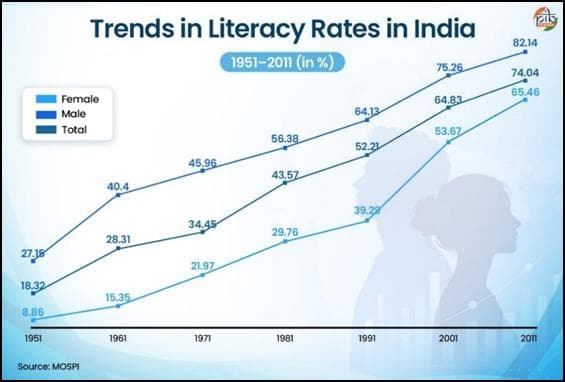
Looking at the statistical progress, the literacy rate was 18.32% in 1951, which grew to 74.04% by 2011. According to PLFS 2025, the literacy rate for people aged 7 years and above is 89% in urban areas and 77.4% in rural areas. Literacy among women has also improved, with the literacy rate for women aged 7 years and above in rural areas recorded at 70.3%.
To promote literacy and education, the government has launched several initiatives under the National Education Policy (NEP) 2020. 'ULLAS' (Nav Bharat Saaksharta Karyakram) is designed for adults aged 15 and above who missed out on formal education. With a budget of ₹1,037.90 crore, this scheme aims to connect 5 crore learners. Meanwhile, the 'NIPUN' Bharat initiative aims to ensure that every child achieves foundational literacy and numeracy by the second grade by 2026-27.
Other significant schemes include 'Samagra Shiksha,' 'PM SHRI' (Prime Minister Schools for Rising India), 'PM e-VIDYA,' and 'PM POSHAN.' According to the UDISE+ report (2025-26), more than 24.72 crore students are enrolled in schools. Higher education has also seen growth, with enrollments increasing from 3.42 crore in 2014-15 to 4.50 crore in 2023-24.
This progress aligns with Sustainable Development Goal (SDG) 4, which aims to ensure inclusive and equitable quality education. The government aims to achieve a 50% Gross Enrolment Ratio (GER) in higher education by 2035 to realize the vision of a Developed India through a literate and skilled population.