East Asia Summit: India Emphasizes Regional Energy Cooperation and Security
At the 20th East Asia Summit held in Manila, India reaffirmed its commitment to energy security and a sustainable energy future.
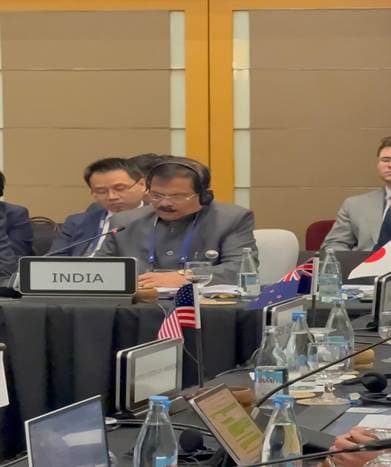
Union Minister of State for Power and New and Renewable Energy, Mr. Shripad Yesso Naik, represented India at the energy ministers' meeting during the 20th East Asia Summit (EAS) held in Manila, Philippines. In his address, Mr. Naik highlighted India's commitment to regional energy cooperation, energy security, and a secure, affordable, and sustainable energy future.
Referring to India's 'Act East' policy and its comprehensive strategic partnership with ASEAN, the Union Minister welcomed the 'ASEAN Plan of Action for Energy Cooperation 2026-2030'. He emphasized the need for collaboration under the ASEAN-India Plan of Action 2026-2030, specifically regarding the ASEAN Power Grid, regional electricity transmission, multilateral power trade, clean energy, and energy security. He further reminded the assembly that Prime Minister Narendra Modi had announced support for the ASEAN Power Grid initiative by training 400 professionals under grid connectivity during the 22nd ASEAN-India Summit in 2025.
Sharing the progress of India's power sector, Mr. Naik stated that as of September 30, 2026, the country's installed power generation capacity has reached 558.8 GW, of which 308 GW (55 percent of total capacity) is derived from non-fossil fuel sources. He informed that India achieved its 2030 Nationally Determined Contribution (NDC) goal five years ahead of schedule, attaining 50 percent cumulative installed capacity from non-fossil sources by June 2025. Additionally, under the PM Surya Ghar project, approximately 50.1 crore rooftop solar panels were installed by September 29, 2026, benefiting 59.5 crore households.
Regarding regional interconnections, the Minister mentioned that India and Singapore are considering options for a proposed 2,000 MW cross-border electricity interconnection. One such option involves a land-based transmission corridor approximately 3,000 kilometers long, which would connect Imphal in India to Singapore via Myanmar, Thailand, and Malaysia.
Mr. Naik expressed India's willingness to share its expertise in renewable energy, grid integration, energy storage, green hydrogen, and clean energy technologies with EAS member countries. He called for strengthening ties between the ASEAN Energy Centre and Indian institutions such as NTPC, PowerGrid, CEA, NIWE, NISE, and NPTI. Furthermore, he outlined a framework for cooperation on topics including strategic petroleum reserves, LNG and gas supply security, battery energy storage, and carbon credit trading schemes.