Privatization of Space Sector Reduces Brain Drain and Opens New Opportunities for Youth: Dr. Jitendra Singh
Union Minister Dr. Jitendra Singh stated that opening the space sector to private companies has created new domestic opportunities for young talent, helping to curb brain drain.
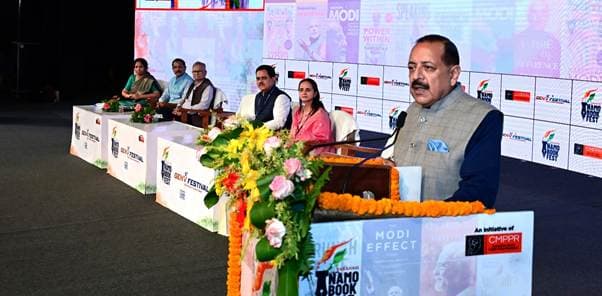
Union Minister of State (Independent Charge) for Science and Technology, Earth Sciences, Atomic Energy, and Space, Dr. Jitendra Singh, stated that opening India's space sector to private companies has generated new employment opportunities for young scientists and technical experts within the country. This has reduced the need for youth to move abroad and has helped in preventing brain drain.
Addressing students during the 'Namo Book Fest' held at the Rudraksh International Cooperation and Convention Center in Varanasi, Dr. Singh explained that previously, many professionals turned to foreign countries due to limited opportunities in the domestic space ecosystem. Now, with the rise of private space startups like Skyroot, extensive possibilities are available for young engineers within India.
Dr. Jitendra Singh emphasized that "the era of silos has ended" and that government institutions, private industries, startups, and academics must now work together to build globally competitive capabilities. He noted that India's space economy, currently valued at approximately 9 billion USD, could grow to 45-46 billion USD over the next 8-10 years.
He clarified that space technology is no longer limited to rockets and missions; it is now being utilized for infrastructure planning, project monitoring, and disaster management. Indian satellites are assisting neighboring countries such as Nepal, Bangladesh, Myanmar, and Sri Lanka by providing early warnings for floods and other disasters.
Discussing India's scientific transformation, he mentioned initiatives such as the Deep Ocean Mission, Quantum Mission, Artificial Intelligence (AI), Cyber Security, and the National Research Foundation. He cited the development of the world's first DNA vaccine against COVID-19 in the field of biotechnology and the Genome India initiative as examples of indigenous capabilities.
Referring to the success of Chandrayaan-3, Dr. Singh stated that India has proven its ability to launch sophisticated missions at a low cost. Additionally, he provided information regarding the opening of the nuclear sector to private participation and the target of achieving 100 gigawatts of nuclear energy capacity by 2047.
Highlighting the government's focus on research, he revealed that the Gross Expenditure on R&D (GERD), which was approximately 46,000-47,000 crore rupees in 2013-14, has now increased to nearly 2 to 2.5 lakh crore rupees. He encouraged students to adopt technologies like AI while emphasizing the importance of maintaining independent thinking and curiosity.