Semicon India 2026 Concludes: 15 Major Announcements to Boost Indigenous Processors, AI, and Quantum Computing
The closing session of Semicon India 2026 at Yashobhoomi, New Delhi, saw the announcement of 15 key initiatives aimed at semiconductor design, indigenous computing, and workforce development.
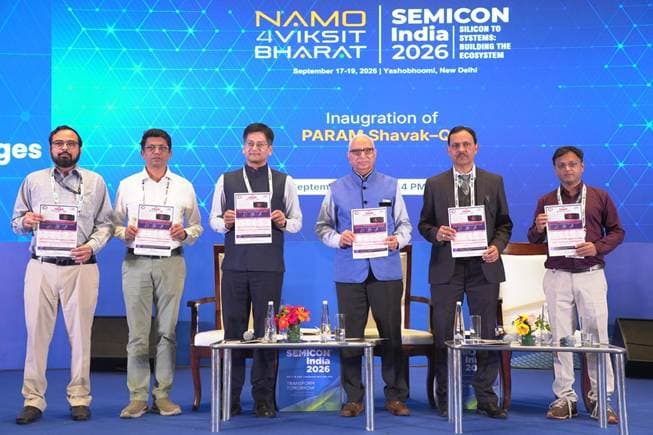
The 'Semicon India 2026' event, held at Yashobhoomi in New Delhi, concluded with 15 major announcements and partnerships. These initiatives are primarily aimed at strengthening India's capabilities in semiconductor design, indigenous computing, fabrication management, Artificial Intelligence (AI), quantum technology, startup engagement, and workforce development.
Under the 'Chips to Startup' (C2S) program of the Ministry of Electronics and Information Technology (MeitY), the winners of the 'Digital India RISC-V' Grand Challenge were announced. A total of 1,236 teams from across the country participated in the competition, with three winning teams receiving prize money totaling 60 lakh rupees. The first prize was awarded to Mivisaai Technologies (SASTRA University) for developing a water cleaning robot based on the indigenous 'Shakti' processor. The second prize went to Digiscope LLP (ER&DCI Institute of Technology) for a digital stethoscope called 'Vega Chikitsa,' and the third prize was awarded to ZetaWave Technologies (IISc Bengaluru) for developing a forest monitoring system.
In terms of technical innovations, the second edition of the 'Bharat AI-SoC Challenge 2026-27,' supported by the UK government, was launched. Additionally, the Semi-Conductor Laboratory (SCL), Mohali, launched the indigenous 'Device Manufacturing Integrated System' (DMIS) for wafer-fabrication management.
In the field of sovereign computing, C-DAC partnered with NLC India Limited to establish data centers in the energy sector and with Bharat Electronics Limited (BEL) to develop high-performance computing and AI solutions. Furthermore, C-DAC unveiled the AI Excellence Lab 'Param Vidya' and the quantum simulation platform 'Param Shavak-QS.'
For workforce development, the Electronics Sector Skills Council of India entered into strategic partnerships with Matrio Labs and TrueChip Solutions. A Memorandum of Understanding (MoU) was also shared between SEMI and Peachtree Elevate. NIELIT announced a digital twin-based initiative for ATMP skilling and semiconductor manufacturing, while the Ramaiah Institute of Advanced Skills and Technology (RIASAT) and IISc Bengaluru signed an agreement for institutional cooperation.
To expand the ecosystem, teams from VIT Vellore and IIT Madras emerged as winners in the Grand Finale of the Semicon India Hackathon. Under the 'Startup Mitra' program, Elfins Technologies secured the first position. At the conclusion of the event, EY and the 'India Semiconductor and Electronics Association' (ISEA) released a report estimating that India's semiconductor market will grow from 64 billion US dollars in 2026 to 200 billion US dollars by 2035.