India Aims for 10% Share in Global 6G Patents and Standards: Dr. Chandra Shekhar Pemmasani
The Union Minister of State for Communications has set a goal to make the next decade 'Intelligent India' and emphasized achieving global leadership in 6G technology.
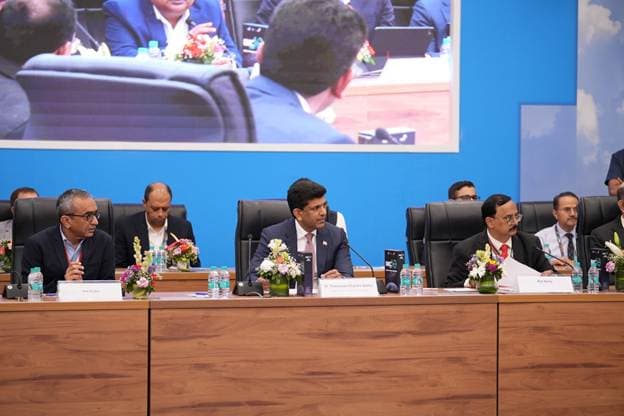
Union Minister of State for Communications and Rural Development, Dr. Chandra Shekhar Pemmasani, shared India's future technological goals while addressing stakeholders of the telecommunications industry. During the session titled "Building Intelligent Infrastructure for 6G: Technology Leadership Dialogue, CTO Roundtable" held during IMC 2026, he stated that while the previous decade belonged to 'Digital India,' the objective for the next decade is to create an 'Intelligent India.'
Dr. Pemmasani highlighted India's goal of securing at least a 10% share in global 6G patents and standards. He urged major telecommunications operators to set annual and quarterly targets for standards, Standard Essential Patents (SEP), and research in universities, alongside industry collaboration.
Promoting indigenous technology, the Minister called for the identification of 10 to 20 critical network technologies currently being imported and the development of Indian alternatives for them. He specifically emphasized developing indigenous solutions in the fields of chipsets, component manufacturing, radios, routers, and optical systems.
Mentioning the achievements of the telecommunications sector, he noted that India has connected over one billion people and linked every district with 5G and villages with 4G through approximately 5.6 lakh Base Transceiver Stations (BTS). Additionally, the country has developed its own indigenous 4G stack. He also discussed the goal of bringing high-speed fiber to every home through BharatNet and 4G saturation projects.
Regarding Research and Development (R&D), Dr. Pemmasani informed that approximately 500 crore rupees have been utilized to fund 136 projects under the Telecom Technology Development Fund (TTDF). These projects are focused on areas such as 5G, 6G, quantum communication, Non-Terrestrial Networks (NTN), and telecommunications security.
He emphasized the need to begin real operator trials for quantum communication through C-DOT and to move beyond AI-collaborative networks toward 'AI-native networks.' Furthermore, he called for prioritizing national security, the security of the supply chain, and the protection of critical telecommunications infrastructure.