Indian Scientists Develop Metal-Free Catalyst to Make Clean Energy Production More Affordable
Researchers have developed a new metal-free organic porous material called TTT-DHTD, which could serve as a cost-effective alternative to expensive platinum in zinc-air batteries.
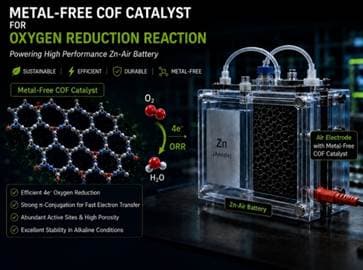
Indian scientists have developed a new metal-free catalyst that could significantly reduce the cost of next-generation clean energy technologies. The material was created by a team of researchers from the S.N. Bose National Centre for Basic Sciences (SNBNCBS) in Kolkata, the Institute of Nano Science and Technology (INST) in Mohali, and SRM University in Amravati, under the Department of Science and Technology (DST).
This specially designed metal-free organic porous material has been named 'TTT-DHTD'. It is composed of 2,4,6-tris(4-aminophenyl)-1,3,5-triazine (TTT) and 4,8-dioxo-4,8-dihydrobenzo[1,2-b:4,5-b']dithiophene-2,6-dicarbaldehyde (DHTD) linkers. Made from abundant elements such as carbon, sulfur, nitrogen, and hydrogen, the material forms a honeycomb-like porous structure that efficiently converts oxygen into electricity.
In zinc-air batteries, the Oxygen Reduction Reaction (ORR) is critical for battery efficiency. Currently, technologies such as hydrogen fuel cells rely on platinum as an efficient ORR catalyst, but platinum is extremely rare and expensive. According to the research, TTT-DHTD is capable of performing similarly to platinum without the use of any precious metals. In laboratory tests, this new catalyst achieved approximately 96 percent of the performance of commercial platinum catalysts and maintained its stability even after 120 hours of continuous operation.
Computer simulations conducted under the supervision of Dr. Pradip Pachphule of SNBNCBS, Professor Ramendra Sundar Dey of INST, and Professor Ranjit Thapa of SRM University revealed that the molecular structure of this material provides ideal sites for oxygen molecules to bind and react, making electricity generation faster and more efficient.
This research has been published in the journal 'Science Advances'. Replacing platinum with affordable organic materials can reduce the cost of zinc-air cells, making clean transportation, portable power systems, and renewable energy storage more affordable and accessible.