PM Modi Addresses UPSC Centenary: Emphasizes 'Nation First' and 'Citizen First' for Viksit Bharat
Prime Minister Narendra Modi highlighted the need for transformation in civil services during the UPSC's 100th anniversary, calling for the adoption of 'Nation First' and 'Citizen First' principles in the selection process.
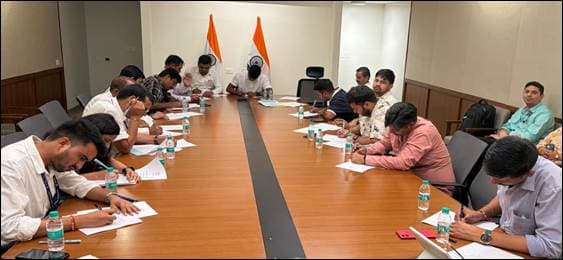
Prime Minister Narendra Modi attended the centenary celebrations of the Union Public Service Commission (UPSC), where he shared his vision regarding the future direction and work culture of the civil services. The Prime Minister described the 100-year journey of the UPSC as a celebration of legacy, noting that while technology, syllabi, and governments have changed over time, the public's trust in the institution has remained unwavering. To mark this historic occasion, a commemorative postage stamp, a coin, and a compilation of 100 significant case laws were released.
During his address, the Prime Minister remembered Sardar Vallabhbhai Patel, stating that he provided the 'steel frame' necessary for the reconstruction of independent India and strengthened the institution. He mentioned that while the priorities were different when the foundation was laid in 1926, the focus after independence shifted toward India's own systems and aspirations.
Discussing the goal of Viksit Bharat, the Prime Minister stated that India in 2047 will be more urbanized and the aspirations of the youth will have grown. He emphasized that mere service delivery is no longer sufficient; public services must now align with the pace of a world characterized by 'instant delivery.' He suggested that the selection process should not only test knowledge but also evaluate why a young person wishes to enter the civil services. He advised trainee officers to write down their original purpose, which could then serve as a self-appraisal tool.
Invoking the mantra of 'Nagrik Devo Bhav,' the Prime Minister proposed a new work culture based on three core principles: Pro-People, Pro-Active, and Good Governance. He asserted that the selection process should identify professionals who possess the empathy to understand the struggles of the poor and the ability to solve problems through innovative methods.
Addressing upcoming challenges, PM Modi mentioned complex issues such as AI, deepfakes, algorithmic bias, and climate justice. He stated that to tackle these challenges, priority must be given to testing 'complex problem solving' and foresight within the selection process. He also emphasized shortening the examination cycle and adopting the principle of 'time certainty' to reduce the economic burden on the youth.
The Prime Minister suggested 'cross-learning' between the UPSC and state selection commissions, as well as the adoption of international best practices. He spoke about capacity building through the use of the i-GOT platform under Mission Karmayogi. Finally, sharing inclusivity data, he noted that the number of female candidates, which was 3 percent in 1952, has now increased to over 30 percent. He also mentioned that the number of candidates appearing for the exam has increased 45-fold compared to 1976, reflecting the country's vast talent pool.
_20261001140953_f92027.jpeg&w=3840&q=75)