Swachhata Udyami Yojana Transforms Lives: Waste Picker Mekala Yesamma Becomes Self-Reliant
Through the Swachhata Udyami Yojana of the Ministry of Social Justice and Empowerment, Mekala Yesamma has improved her financial status, increasing her monthly income from 8,000 to 18,000 rupees.
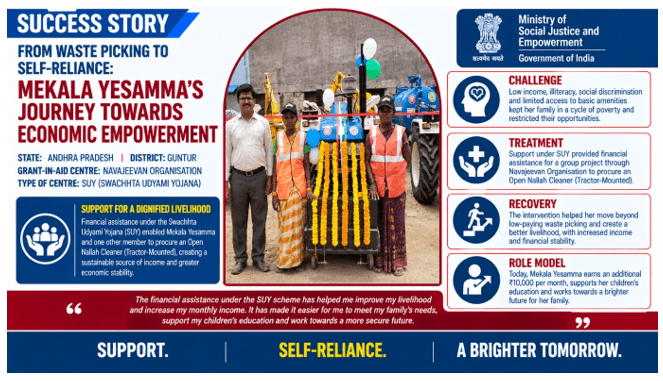
Initiatives by the Ministry of Social Justice and Empowerment are providing sustainable livelihoods and economic empowerment to people from marginalized communities. A vivid example of this is the journey of 33-year-old Ms. Mekala Yesamma, who belongs to the Scheduled Tribe (ST) community.
Having worked as a waste picker for the Guntur Municipal Corporation for the past 12 years, Ms. Mekala was deprived of education due to financial hardships. Because of low income and limited opportunities, she faced significant difficulties in meeting the basic needs of her family and securing her children's future.
The turning point came on June 19, 2023, when Ms. Yesamma received financial assistance under the 'Swachhata Udyami Yojana' (SUY) of the National Safai Karamcharis Finance and Development Corporation through the Navjeevan organization. This assistance was used to purchase a tractor-mounted 'Open Nala Cleaner' as part of a group project. The total cost of the project was 16,99,952 rupees, which included a loan of 10,24,964 rupees and a capital subsidy of 6,74,988 rupees.
The impact of this scheme has led to a remarkable improvement in her financial condition. Before receiving the assistance, Ms. Yesamma's monthly income was approximately 8,000 rupees, which has now increased to about 18,000 rupees. This additional monthly income of 10,000 rupees has enabled her to support her children's education, manage household expenses, and improve her family's standard of living.
Expressing her gratitude for her success, Ms. Mekala Yesamma stated, "The financial assistance received under the SUY scheme has helped me improve my livelihood and increase my monthly income. This has made it easier for me to meet my family's needs, support my children's studies, and work toward a secure future."
This case demonstrates how timely financial assistance and livelihood opportunities can make marginalized sections economically self-reliant and provide them with a dignified place in society.