India International Water Week 2026: Discussions on Technical Solutions for Water Security and Climate-Resilient Management
The second day of the 9th India International Water Week in New Delhi featured various technical sessions on water security, greywater management, and AI-enabled solutions.
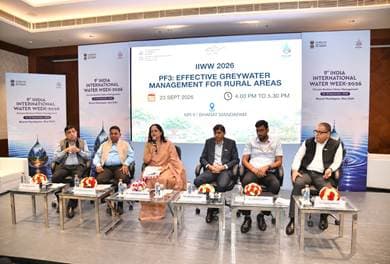
The second day of the 9th India International Water Week (IIWW 2026), held at Bharat Mandapam in New Delhi, focused on the theme of 'Climate-Resilient Water Management.' Organized by the Ministry of Jal Shakti, the event involved detailed discussions on the future of water management, AI-enabled solutions, and various dimensions of resilient WASH (Water, Sanitation, and Hygiene) services.
During the event, Mr. Ashok K.K. Meena, Secretary of the Department of Drinking Water and Sanitation, addressed the Country Forum led by the Netherlands. He stated that water management is not merely an engineering challenge but also a challenge of governance, community, and climate resilience. Referring to the Jal Jeevan Mission, he noted that the focus is now shifting from the construction of infrastructure toward sustainability, quality of service, and long-term water security. Mr. Meena emphasized India-Netherlands cooperation, citing initiatives such as the 'Sujlam Bharat Digital Public Infrastructure' and Decision Support Systems for source sustainability.
Ms. Aishwarya Singh, Joint Secretary and Mission Director of Swachh Bharat Mission (Gramin), chaired a technical session on effective greywater management for rural areas. Experiences from Andhra Pradesh, Sikkim, Bihar, Jammu and Kashmir, and Jharkhand were shared during this session. Ms. Singh clarified that there is no one-size-fits-all solution for greywater management; instead, it must be adapted according to local conditions and community needs. The session highlighted that greywater management systems have currently been implemented in approximately 5.46 lakh villages.
Simultaneously, the second International WASH Conference featured six main technical sessions where a total of 25 research papers were presented. These sessions covered topics such as digital technology for WASH, AI and innovation, governance, community participation, climate resilience, water quality, and economic models. The research papers demonstrated technical aspects such as digital monitoring for rural sanitation in Bihar, smart water meters, and AI-driven decision support systems.
Other significant parts of the program included the 'Water Leaders Forum' and the 'Practitioners Forum.' Discussions in these forums focused on experiences with micro-irrigation, solar pumps, and digital mapping in states like Maharashtra, Gujarat, Karnataka, and Bihar. Additionally, a session organized by the German Embassy discussed India-Germany cooperation to accelerate 'India's Water Vision 2047,' featuring a keynote address by Mr. Raj Bhushan Chaudhary, Minister of State for Jal Shakti, and an opening address by German Ambassador Jasper Week.
Under the thematic forum, research papers were presented on subjects such as inclusive water governance, the reuse of treated wastewater, and community participation in groundwater recharge. Furthermore, a special session on financing and innovation was organized by the World Bank and the International Water Management Institute (IWMI) to maximize the impact of the Pradhan Mantri Krishi Sinchayee Yojana (PMKSY).